


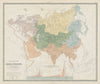


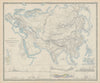


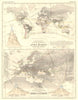

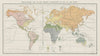

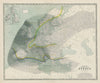

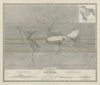

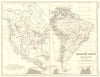

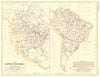

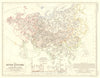

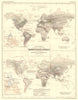

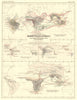

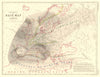

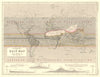


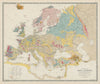


Winds, ocean currents, volcanoes and the distribution of animals all find a place in The Physical Atlas of Natural Phenomena, an atlas of unusually broad scientific scope. Alexander Keith Johnston compiled it for William Blackwood & Sons of Edinburgh and London, and the sheets here, from 1850 and 1856, cover rainfall, terrestrial magnetism, geology and zoology. Drainage maps divide the Americas, Europe and Asia by watershed rather than frontier, animal plates relate species to latitude and altitude, and sections and diagrams make physical processes visible. The atlas also records Victorian attempts to classify human populations and disease geographically, with the assumptions and limitations of the scholarship of its day.
EU orders up to €150 are sent VAT- and duty-paid — no additional taxes on arrival
Authenticity Guaranteed - We only sell original antique & vintage items
Can we help? Call us on +44-208-960-3476 • FAQs
All our products are exempt from US tariffs — no additional duties or taxes payable on arrival.


- Shop by Country
- Shop by Cartographer
- Shop Maps by Type
- Shop Prints by Subject